
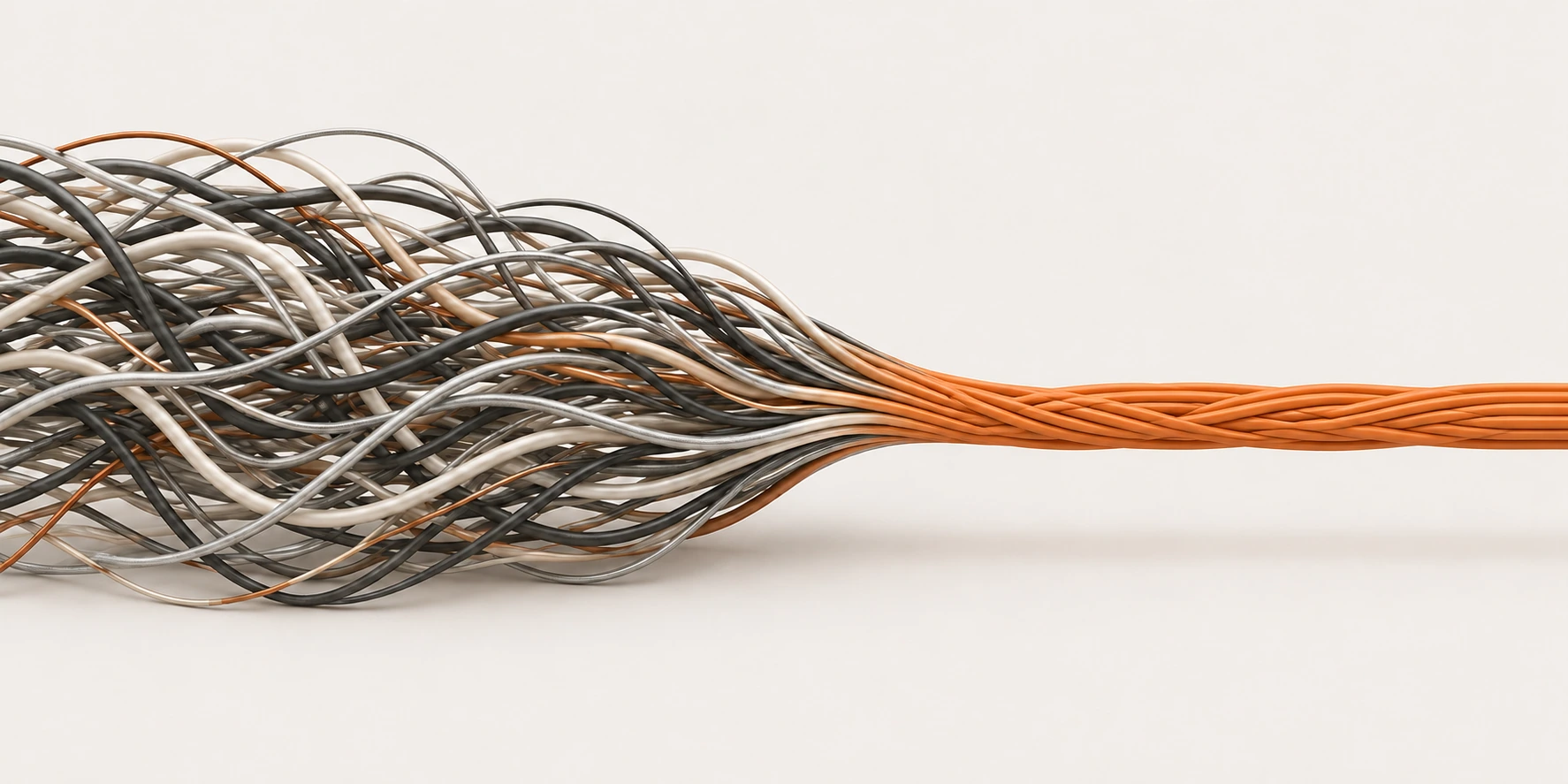
The request arrives.
Documents arrive with the data defined for the process. Missing information needs to be checked.
Documents and informationAn illustrative document workflow.
A request moves through systems, automations and review points. See how each step connects to the next.
Documents arrive with the data defined for the process. Missing information needs to be checked.
Documents and informationRules guide the routing. Questions and exceptions go to human review.
Rules and automationRecords help assess the delivery and decide the next step.
People and recordsEvery step has a next step.
Requests, rules and people connected in one design. See how the process finds its next step.
An illustrative document workflow.
Select a node to understand its role in the process.
One intake point brings the request together and connects the first check.
Requests, documents and information enter the same flow. Each step connects clearly to the next.
From request to reviewProcess criteria guide the destination. The main path moves forward; anything that needs assessment goes to a person.
One decision, two possible pathsQuestions and incomplete information have a review point. After a person assesses them, the request rejoins the routing flow.
Review is part of the flowAn agent organizes the intake. Document processing prepares information for review, keeping each task connected to its process step.
Agent and document processingAn API can retrieve information. A robot can carry out a data entry routine. Execution depends on the access available in each system.
API and interface automationCriteria guide the routing. When an issue needs assessment, a person decides and reconnects the request to the flow.
Human review and routingThe design specifies which information each task needs. Purpose and access guide how data is used in document processing, queries and data entry.
Scope, purpose and accessThe model, instructions and context are part of defining the process. Usage limits and review criteria guide where AI can act.
Model, instructions and criteriaIssues have a person responsible for assessing them. The design also provides for recording the decision before routing.
People and recordsThree areas of work to organize decisions, connect workflows and evolve systems.
Define criteria for using AI, with clear responsibilities and review points.
The scope and acceptance criteria are defined with the team responsible.
Connect steps, information and systems around the needs of each workflow.
The scope and acceptance criteria are defined with the team responsible.
Plan the evolution of existing systems, accounting for dependencies and continuity.
The scope and acceptance criteria are defined with the team responsible.
The first step is to choose a process and understand its context.
From receiving a request to routing it, try a workflow with rules and human review.
Local simulation with three fictional requests.
Gather the three sample requests.
Identify missing documents.
Separate direct routing from review.
Document workflow / local example
Ready to begin. Move through the steps at your own pace.
A workflow is clearer when it shows what can advance and what needs a person.
Select a step or a request. For PED-1043, you can add a sample document and confirm the review.
Explore the issueThe demonstration uses sample fields and rules. It does not use AI to read documents or connect to external systems.
Select a step to understand its role in the workflow.
Requests → Check → Routing. When needed, the check routes a request to a person, who reviews it and returns it to the workflow.
The example brings together three fictional requests. Start the demonstration to follow their arrival.
Which of your team’s workflows can we understand first?